The Recovery Tips I Wish I Knew Earlier
As someone who has always had a “push through the pain” mentality, college athletics was a rude awakening.
Growing up, I believed that if something was hard, you just had to suck it up and get it done. To an extent, this is true. There are days when you’re exhausted, mentally drained, or really just not in the mood, and pushing through these moments is part of what makes you a better athlete. However, this mentality starts to fall through when dealing with physical hardships.
There is a difference between being uncomfortable because you are sore and tired, and pushing through an injury your body is trying to warn you about. Acknowledging and understanding the difference between these two is a crucial tip to learn before making it to college athletics.
Ignoring pain from your body doesn’t make you tougher; it just keeps you off the field for longer. I learned this the hard way. Sometimes, I am still learning this the hard way.
The jump from high school to college sports is massive- regardless of division. Practices are longer, lifting is heavier, conditioning is faster, and recovery windows become shorter. The mental and physical demands become extreme and if you are not taking care of your body, you will not last. That is not to scare anyone off; it is the truth. If you don’t prioritize recovery, your body will make that decision for you.
When your body feels good, your mind performs better. You move with more confidence, work harder, and ultimately just become a better player.
When people talk about recovery, they usually mention three familiar things; eat enough, drink enough, sleep enough. They’re repeated so often that it can be easy to tune them out, however they are repeated for a reason. These are without question the three foundations of recovery.
You could be doing everything else on this list to perfection, but it will not make up for only sleeping three hours a night or only eating one meal throughout the day.
Although these are the most important, it is so much more than that. I have dealt with a fair share of injuries in college. From attempting to run off sprained ankles, to over pushing such bad shin splints I gave myself multiple stress fractures, to even currently playing with a broken thumb. I’ve made many changes in my recovery habits since starting college to minimize and maintain injuries.
Recovery is an extremely important part of elite athletes' routines that should be a part of yours too. It is not just one habit; it is a collection of little things done every day. Here are some of my nonnegotiable tips that I prioritize when recovering.
The Importance of Active Recovery:
In the chaos of collegiate sports, it is easy to assume the one day off a week is a day to do absolutely nothing and lay in bed all day. And although relaxing and staying off your feet is an important part of an off day, active recovery is just as important. Even just 20 minutes every off day adds up to make a huge difference in muscle repair, reducing stiffness, and maintaining mobility to feel your best.
The most important part is remembering to keep the intensity low to promote recovery and not add more fatigue! This was an adjustment for my mentality, but trying to burn the most calories or sweat the hardest is not the way to treat an active recovery day.
My personal favorites are walking, light biking, yoga, mobility, and stretching. Grabbing a friend and walking to coffee in the morning or throwing my yoga mat on the balcony and stretching while watching people walk by. Not only is this fuel for the body, but fuel for the mind!
Workouts are hard every other day of the week. Allow your day off to be a day to slow down and move your body without having to exert yourself.
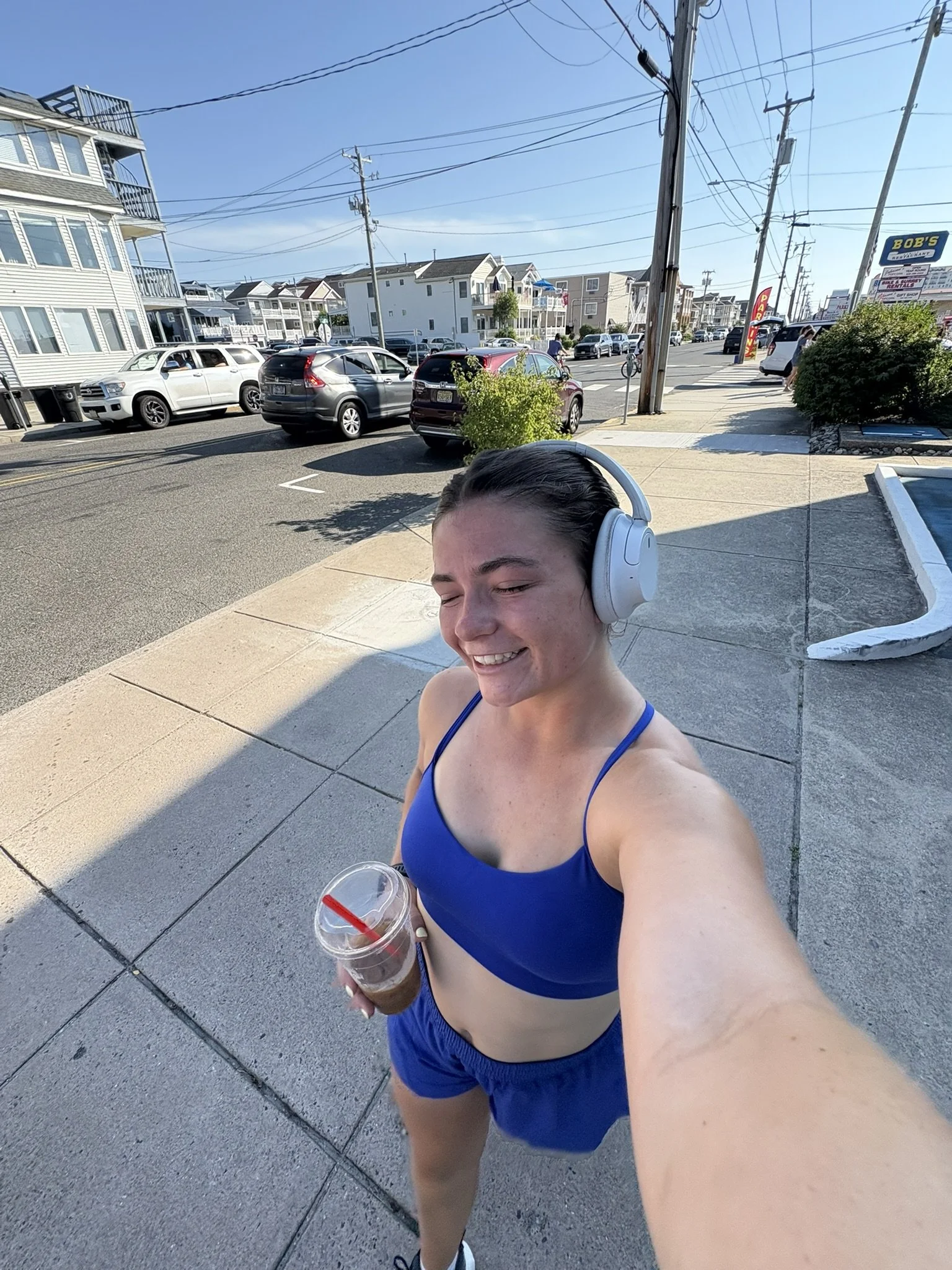
Walk for Coffee, July 2026
Utilizing Athletic Trainers:
Your athletic trainer is your best friend. Let me repeat: Your athletic trainer is your best friend! They are one of the most important resources provided to a college athlete. The most common misconception is that they should only be used when you are injured. That is not the case AT ALL!
It can be very difficult for a freshman to ask for treatment when you feel a sore ankle or a tight shoulder. But ignoring the little aches and pains can become the root of a much larger problem in the future. My sophomore season I dealt with what I believed to just be standard shin splints for the whole year. I never saw the trainer, barely treated them (usually just ice), and chose to ignore the pain.
By the last two weeks of the season, I could barely walk. I was told by my trainers I had multiple stress fractures specifically in my right leg that were untreated for so long, I was in a boot and could not run for more than 12 weeks. I was also informed had I gone to get real treatment from the trainers earlier, that could have been avoided or at the very least maintained.
It is not rocket science. Go to the trainer when you are hurting. And do not downplay any bumps, bruises, or pain when seeing them.
The Importance of Recovering Your Mental Health:
The mental side of sports is just as important as the physical side. Just like you need to take time to recover your body physically, you need to recover mentally. Between the stress of practice, lift, conditioning, classes, homework, meetings, and social life, it can be easy to lose yourself or feel yourself drowning in your sport rather than swimming in it.
The stress you carry mentally manifests itself physically. Whether it's symptoms of sickness, muscle fatigue, or something different, it can easily be triggered by an immense level of stress.
I’ve found that the best recovery days consist of doing something for myself. Walking to get coffee with a friend, reading, deep cleaning my room, or going to see a movie. Taking a break from the constant pressure of performing allows you to play your best!

Picnic in Central Park, September 2025
Your identity is bigger than your sport. Make time for your hobbies or traditions and prioritize those just as much as getting in extra reps. When you take care of your mental health; your physical health follows, making you a healthier and happier player.
If you want to read more about my personal journey by prioritizing my mental health and discovering my identity beyond lacrosse, check out my article titled “More Than an Athlete: Why Your Identity Matters”.
One of the biggest mindset shifts I’ve faced as an athlete is understanding that taking care of yourself doesn’t mean doing less. It’s about giving your mind and body what it needs to keep showing up, to be a better player. The way you recover directly impacts how you perform.
So, whether it’s prioritizing sleep, drinking enough water, fueling your body with the proper food, going on a walk with friends on an off day, seeing the trainer, or just giving yourself some time away from your sport, recovery is how you become a better player.
College athletes will ask more of your body than you’ve ever thought was possible. Everything adds up: but the question usually isn’t whether you are willing to work hard. It is whether or not your body will show up for you. The athletes who run the longest, sprint the fastest, and lift the heaviest aren’t just tough. They are the ones who know that part of competing is taking care of your body. Treat your body with the same dedication you bring to every game, or one day you might not get the opportunity to.
